Important
Health care sharing ministries in Florida are not health insurance. Members voluntarily share one another’s medical bills, but no one is legally required to pay your bills. Under Florida law, these programs are exempt from the Florida Insurance Code and its consumer protections. You remain personally responsible for your own medical bills whether or not anything is shared.
What Is a Health Care Sharing Ministry?
A health care sharing ministry (HCSM) is a nonprofit organization whose members, usually Christians who agree to a statement of faith, send in a monthly amount that is used to pay other members’ eligible medical bills. When you have a bill, the ministry reviews it against its written guidelines and, if it qualifies, matches it with other members’ contributions.
Many people, including self-employed workers and families facing high premiums, are drawn to them because the monthly cost can be lower than an unsubsidized health plan, enrollment is open all year, and the faith-based community matters to them. Those are real reasons. The tradeoff is that a sharing ministry has no legal obligation to pay, it can exclude whole categories of care, and its rules can change while you’re a member.
The largest Christian ministries include Medi-Share (run by Christian Care Ministry, headquartered right here on the Space Coast in Melbourne), Samaritan Ministries, Christian Healthcare Ministries (CHM), and Liberty HealthShare.
How Medi-Share Works and What It Costs
The steps below follow the Medi-Share Complete guidelines that took effect November 17, 2026. Medi-Share uses its own terms, so we’ve added the closest insurance equivalent in parentheses.
1. Monthly Share (like a premium)
You deposit your share each month into a sharing account at a bank Medi-Share designates. Your share is assigned to other members’ eligible bills. If you go more than two months without depositing, your membership is cancelled.
2. Annual Household Portion (like a deductible)
Your household pays its eligible bills up to the AHP you choose ($3,000, $6,000, $9,000 or $12,000) before sharing begins. It resets every 12 months, and it resets to $0 any time you change AHP levels.
3. Provider Fee (like a copay)
You pay a fee at every office, hospital and ER visit. It does not count toward your AHP, and you keep paying it even after the AHP is met.
4. Pre-Notification (like prior authorization)
Your provider must notify Medi-Share before hospital stays, non-emergency surgery, cancer treatment, transplants and specialty drugs. For emergencies, notice is due within 72 hours. Pre-notification does not guarantee sharing.
5. Bills Reviewed After Care
Eligibility is decided after you get care, partly by reviewing your medical records from the 36 months before you joined. Bills must reach Medi-Share within 12 months of the date of service.
6. Network Discounts
Members are encouraged to use preferred (PPO) providers. If you go out of network, you’re responsible for charges above set limits (for example, above 150% of the Medicare rate for professional services), unless a waiver applies.
What does Medi-Share cost?
Your share depends on your household’s ages, its size and the AHP you choose. Medi-Share’s own published examples range from about $150–$250 a month for a single person in their 30s with a $12,000 AHP to about $650–$850 a month for a family of four in their 50s with a $9,000 AHP. A health incentive discount is available to members who meet certain health standards each year. Some applicants are required to join the Health Partner coaching program, which carries an extra monthly fee.
Pricing examples are from Medi-Share’s published materials and are not a quote. Get exact figures from Medi-Share.
Who Qualifies for Medi-Share?
- Christian faith: Every adult 18 and older must attest to a personal relationship with Jesus Christ, agree to Medi-Share’s Statement of Faith, and regularly attend a fellowship of believers.
- Lifestyle: You must have avoided tobacco (vaping and nicotine replacement included) and illegal drugs for at least 12 months before you apply, and you must not abuse alcohol or prescription drugs. Sexual relations are limited to marriage as Medi-Share defines it.
- Medical records: You authorize Medi-Share to collect medical records for everyone in your household going back 36 months. These records are used to identify pre-existing conditions.
- Age: Medi-Share Complete is for people under 65. Members must move to Medi-Share 65+ when they turn 65, and that program requires Medicare Parts A and B.
- Adult children: Unmarried children can stay on a parent’s membership until age 23. Within 60 days of turning 18, they must sign their own faith and lifestyle commitment.
Breaking the lifestyle standards can lead to unshared bills or cancellation of your membership.
What Doesn’t Medi-Share Cover?
Under the current guidelines, the following are generally not eligible for sharing:
Routine & Preventive
Immunizations, screening mammograms, screening colonoscopies, routine labs and vision care. Medi-Share does share one annual physical per member, plus an A1c test and lipid panel, for members who joined or changed AHP on or after September 1, 2020. Well-child visits are shared until age 6.
Mental & Behavioral Health
Counseling, psychotherapy and psychiatric care. A psychiatric evaluation and medication for mental illness tied to an eligible medical condition can be shared for 6 months. Members get phone and video counseling through the member center.
Lifestyle-Related Care
Injuries related to alcohol or drugs, most sexually transmitted diseases, maternity for pregnancies conceived outside marriage (with an exception for rape), and injuries from illegal acts.
Family Planning
Birth control, infertility testing and treatment, and sterilization or its reversal.
Supplies & Equipment
Diabetic, wound care and ostomy supplies, over-the-counter drugs, hearing aids and shoe inserts.
Other Exclusions
Most dental care, TMJ treatment, weight management, alternative and functional medicine, regenerative medicine such as stem cell and PRP therapy, cosmetic procedures, and custodial or long-term care.
Sharing Limits and Waiting Periods
Medi-Share has no annual or lifetime maximum for most eligible bills. The important exceptions are:
| Situation |
How Medi-Share Handles It |
| Pre-existing conditions |
A pre-existing condition is anything with signs, symptoms, testing, diagnosis, treatment or medication in the 36 months before you joined. It isn’t shared at all until you’ve shared faithfully for 36 consecutive months. After that, sharing is capped at $100,000 per year, rising to $500,000 per year after 60 months. |
| Prescriptions |
Prescriptions are shared for 6 months per new condition. Maintenance drugs aren’t shared after that, with limited exceptions for cancer and transplant patients. Drugs for pre-existing conditions are never shared. |
| First month of membership |
Up to $50,000 of eligible bills can be shared. |
| Maternity |
You must be married, have an AHP of $3,000 or higher, and have shared every month from conception through delivery. Sharing begins after the AHP is met and is capped at $125,000 per pregnancy, including the newborn’s care until the baby first goes home. |
| Therapy & facility care |
Physical, occupational and osteopathic therapy: 20 visits combined. Home care: 60 days. Skilled nursing or rehab facility: 30 days. Chiropractic care: only in place of surgery, up to 20 visits. |
| Motorcycle accidents |
Capped at $100,000 in any 12-month period. If you weren’t wearing a legally required helmet or seatbelt in a vehicle accident, you also pay an extra 15% of the first $100,000. |
| Other coverage available |
Bills that any insurance (auto, workers’ comp, etc.) or a responsible third party should pay aren’t shared. If Medi-Share does pay them, it can recover the money from your settlement. |
If You’re Healthy Now
If you’re healthy, take no regular prescriptions and have no pre-existing conditions, a sharing ministry may work fine for you. A lower monthly share can mean real savings. Many members go years with only minor bills, and a new condition that starts after you join is generally eligible for sharing.
The risk shows up if your health changes after you join. These are the situations to think about:
A new chronic condition means ongoing drug costs
Say you’re diagnosed with diabetes, high blood pressure, rheumatoid arthritis or MS after joining. Medi-Share shares prescriptions for that new condition for only 6 months. After that, maintenance medication is generally yours to pay, often for the rest of your life. Limited exceptions apply for cancer and transplants.
You can’t easily switch back
An ACA plan would cover your new condition from day one. But leaving a sharing ministry generally doesn’t open a Special Enrollment Period, so you’d likely have to wait for the next Open Enrollment, with coverage starting January 1. Until then, you either stay in the ministry or go without.
Changing ministries restarts the clock
If you move to a different sharing ministry, your new diagnosis is a pre-existing condition there. That usually means waiting periods and caps all over again.
Missing payments can cost you the condition
If Medi-Share cancels your membership because you went more than two months without sharing and you later reapply, conditions that started during your earlier membership can be treated as pre-existing.
Some needs aren’t shared no matter what
Counseling after a hard diagnosis, diabetic supplies, hearing aids and long-term care aren’t shared, even if the underlying condition is new.
The rules can shift mid-treatment
The guidelines in effect on each date of service apply. A rule change during a long treatment can affect bills you haven’t received yet.
If you stay healthy, you save money. If you develop a long-term condition, you could be paying for medications and care with no out-of-pocket ceiling and no way back to ACA coverage until Open Enrollment. Before joining, consider whether you could afford that.
Samaritan Ministries, CHM and Liberty HealthShare
Each ministry has its own guidelines. A brief summary of three others follows. Read each program’s current guidelines before you join.
Samaritan Ministries
Based in Peoria, Illinois. Members often send their shares, along with notes and prayers, directly to the member who has a need. Samaritan Classic has a $1,000 initial unshareable amount per need and shares up to $250,000 per need. Samaritan Basic has a lower monthly share, a $2,000 initial amount and 90% sharing. Members can join an optional Save to Share program for needs above the limit. There are no network restrictions.
Christian Healthcare Ministries
Operating since 1981, CHM prices membership by “unit” (each person). It offers Gold, Silver and Bronze programs, with personal responsibility of $1,250, $3,000 or $6,000 per incident, plus SeniorShare for Medicare members. The standard limit is $125,000 per illness. The optional CHM Plus add-on raises that limit. Maternity is shared on Gold only.
Liberty HealthShare
Based in Canton, Ohio, Liberty HealthShare offers six sharing programs, including one for people on Medicare. It reports strong enrollment growth, lowered family share amounts in 2026, and has announced lower co-shares on two programs for 2027. In 2022, Orlando Health sued Liberty, alleging about $1.1 million in unpaid balances.
Program details are summarized from each ministry’s published guidelines and announcements as of November 2026 and can change. Contact the ministry for current terms.
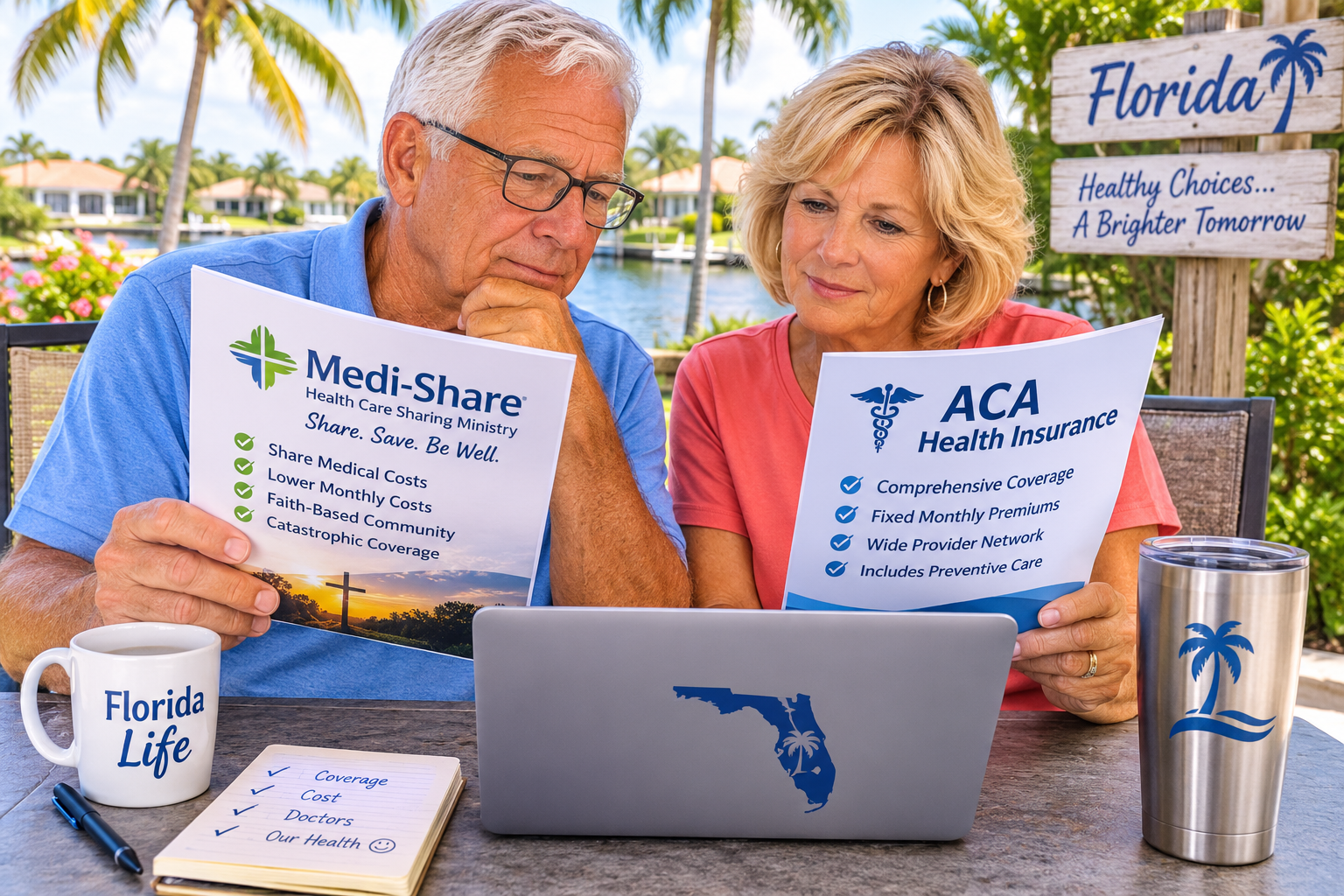
Comparing a sharing ministry with an ACA plan? Look past the monthly cost to what’s actually covered.
Medi-Share vs. Obamacare (ACA Plans)
| Feature |
Sharing Ministry (e.g., Medi-Share) |
ACA Marketplace Plan |
| Is it insurance? |
No. Payment is voluntary and not guaranteed. |
Yes. Covered claims must be paid under a legally binding contract. |
| Pre-existing conditions |
Not shared for 36 months, then capped (Medi-Share). Rules vary by ministry. |
Covered from day one. You can’t be denied or charged more for your health. |
| Preventive care |
Mostly excluded, aside from limited exceptions. |
Covered at $0 in-network. |
| Mental health |
Counseling and therapy generally excluded. |
An essential health benefit. |
| Prescriptions |
Limited (6 months per new condition at Medi-Share). |
Covered under the plan’s formulary. |
| Out-of-pocket cap |
Your AHP plus per-visit provider fees, plus anything ineligible, over a limit or out of network. |
Capped by federal law at $12,000 for an individual and $24,000 for a family in 2027 (some Bronze plans may go to $15,600 / $31,200). |
| Financial help |
No government subsidies. Some ministries offer hardship help. |
Premium tax credits for eligible incomes. Many people pay far less than full price. |
| When you can join |
Any time of year, if you qualify. |
During Open Enrollment or a Special Enrollment Period. |
| If you disagree with a decision |
Internal appeal, then a member panel, then Christian mediation and binding arbitration. Medi-Share members waive the right to sue. |
Internal appeal, independent external review, and state regulators. |
| Can the rules change? |
Yes, by member vote or board action. The guidelines in effect on your date of service apply. |
Benefits are locked for the plan year. |
2027 Open Enrollment: Open Enrollment on HealthCare.gov runs November 1, 2026 through January 15, 2027. Enroll by December 15 for coverage that starts January 1. Joining or leaving a sharing ministry generally does not open a Special Enrollment Period, so if you’re on the fence, decide during Open Enrollment.
Risks to Understand Before You Join
- No guarantee of payment. Medi-Share’s own guidelines say plainly that payment of your bills is not guaranteed and that you remain responsible for them.
- Eligibility is decided after care. A preliminary review is available, but the final decision comes only after your bills are submitted, and new information from your records can change it.
- The rules can change while you’re a member. The guidelines in effect on the date you receive care are the ones that apply, not the ones in effect when you joined.
- Limited legal recourse. Florida’s insurance regulators can’t make a ministry pay a bill. At Medi-Share, disputes go to Christian mediation and binding arbitration instead of court.
- Some programs have failed. Several years ago, regulators in multiple states acted against Aliera and the Trinity HealthShare ministry it marketed, which became Sharity Ministries, after consumers were left with unpaid bills. Sharity later went bankrupt. Choose established ministries and read their audited financials.
It may work if you:
- Are healthy, with no ongoing conditions or regular prescriptions
- Earn too much for meaningful ACA subsidies
- Value the faith community and agree with the lifestyle standards
- Have savings to cover your AHP and any unshared bills
Use caution if you:
- Have a pre-existing condition or take maintenance medication
- Qualify for ACA premium tax credits
- Need mental health care, are planning a pregnancy, or use diabetic supplies
- Couldn’t absorb a large unshared bill
What Florida Law Says
Since 2008, Florida Statute 624.1265 has exempted qualifying nonprofit religious organizations from the Florida Insurance Code. To keep that exemption, a ministry must, among other things, provide members a written notice that it is not insurance and is not subject to the Code’s consumer protections. It must also not market or sell through agents licensed by the Florida Department of Financial Services.
A 2026 bill (SB 834) would have allowed licensed agents to sell sharing ministry memberships. It passed the Senate but died in the House in March 2026, so the restriction still stands.
What that means for you: NISONA does not sell sharing ministry memberships and earns nothing if you join one. Our job is to give you an honest side-by-side with the ACA and other options we do offer, so you can make an informed decision.
Questions to Ask Before You Join Any Sharing Ministry
- How do you define a pre-existing condition, and how far back do you look?
- Are my current prescriptions shared, and for how long?
- What is the per-illness, annual or lifetime sharing limit?
- What happens to bills over that limit?
- What percentage of member contributions goes to administration?
- Can I see your most recent audited financial statements?
- How long does it take bills to be shared, and will providers bill me in the meantime?
- How are disputes handled, and am I giving up my right to go to court?
- How often do the guidelines change, and do changes apply to care I’m already receiving?
Frequently Asked Questions
Is Medi-Share health insurance?
No. Medi-Share is a health care sharing ministry run by Christian Care Ministry, a Florida nonprofit. Its guidelines state that it is not insurance, that payment is not guaranteed, and that members are always responsible for their own medical bills.
Is there a penalty for not having health insurance in Florida?
No. The federal individual mandate penalty has been $0 since 2019, and Florida doesn’t have its own mandate. That’s true whether you have a sharing ministry or no coverage at all.
Does Medi-Share cover pre-existing conditions?
Not right away. Conditions in your records from the 36 months before you joined aren’t shared until you’ve been a faithful member for 36 months. Sharing is then capped at $100,000 a year, rising to $500,000 after 60 months. Prescriptions for those conditions are never shared.
Can I use my ACA subsidy toward a sharing ministry?
No. Premium tax credits apply only to Marketplace plans. If you qualify for a subsidy, compare your actual after-subsidy ACA premium before deciding.
Can I switch from Medi-Share to Obamacare (an ACA plan)?
Yes, but usually only during Open Enrollment (November 1 through January 15). Leaving a sharing ministry generally doesn’t qualify you for a Special Enrollment Period, so outside Open Enrollment you’d need another qualifying life event, such as a move or a marriage.
Does Medi-Share cover prescriptions?
Only for a limited time. Prescriptions for a new condition are shared for 6 months from diagnosis. Starting a new drug for the same condition doesn’t restart that 6 months. Prescriptions for pre-existing conditions are never shared. Limited exceptions are available for cancer and transplant patients.
Does Medi-Share cover maternity?
For married members only. You need an AHP of $3,000 or higher, and you must have shared every month from conception through delivery. Sharing starts after your AHP is met and is capped at $125,000 per pregnancy. Pregnancies conceived outside marriage aren’t shared, except in cases of rape reported to law enforcement.
Does Medi-Share cover mental health counseling?
No. Counseling and psychotherapy aren’t shared. A psychiatric evaluation and medication related to an eligible medical condition can be shared for 6 months. Members get phone and video counseling through Medi-Share’s member center.
What happens if Medi-Share doesn’t pay my bill?
You still owe the provider. You have 90 days to ask Christian Care Ministry to review the decision. If you disagree with that result, you have another 90 days to request a seven-member appeal panel. After that, disputes go to Christian mediation and then binding arbitration. Because sharing ministries aren’t insurance, Florida’s insurance regulators can’t order a ministry to pay.
Medi-Share vs. Samaritan Ministries vs. Liberty HealthShare: which is better?
None of them is best for everyone. Medi-Share has no annual or lifetime limit on most eligible bills and uses a PPO network. Samaritan Classic shares up to $250,000 per need and has no network. Christian Healthcare Ministries caps most needs at $125,000 per illness unless you add CHM Plus. Liberty HealthShare offers six programs. Compare each one’s pre-existing condition rules, prescription sharing and limits using the questions above.
What happens to Medi-Share when I turn 65?
You must move to Medi-Share 65+, which requires Medicare Parts A and B. At 65, compare that with a Medicare Supplement or Medicare Advantage plan. See our Medicare guide.
Request a Side-by-Side Comparison
Tell us what a sharing ministry quoted you. We’ll show you your 2027 ACA options, with any subsidy you qualify for, at no cost.
NISONA • 1627 US Hwy 1, Suite 220, Sebastian, FL 32958 • Serving Sebastian, Vero Beach, Port St. Lucie, Stuart, Melbourne, Palm Bay and the Treasure and Space Coasts
Disclaimer: This page is general education, not legal or tax advice, and is not an endorsement of or recommendation against any ministry. NISONA is not affiliated with Christian Care Ministry, Samaritan Ministries, Christian Healthcare Ministries or Liberty HealthShare. Program details change, so always read a ministry’s current guidelines before joining.
Sources: Medi-Share Complete Program Guidelines (effective November 17, 2026); Medi-Share published pricing examples; Samaritan Ministries Guidelines for Health Care Sharing (August 2025); Christian Healthcare Ministries program materials (2026); Liberty HealthShare announcements (2026); Florida Statute 624.1265; Florida Senate CS/CS/SB 834 (2026) bill history; CMS 2027 Notice of Benefit and Payment Parameters; HealthCare.gov.